^ LISTEN TO THE INTERVIEW ABOVE ^
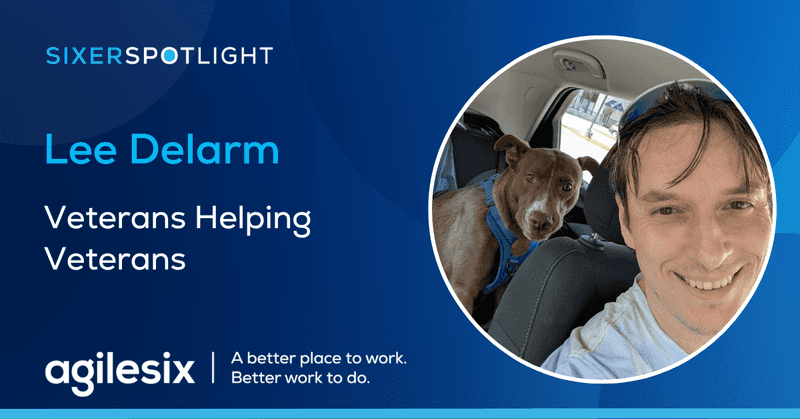
Joining us today is Lee Delarm, a Veteran and software engineer at Agile Six. Lee shares his journey from the Air Force to a place he didn't expect to find, a company where purpose and people matter. Today, his work helps hundreds of thousands of Veterans each week access care and benefits they've earned. In his community, he chooses to be a single brick in the lives of the people around him, helping others build something of their own. This is a conversation about purpose, values, community, and what it looks like to build a better path for yourself and for others.
Meet Lee Delarm
I'm a Veteran, a volunteer firefighter, a software engineer, a game developer, a mentor at a local elementary school, someone who teaches carpentry to kids, a farmer, and a dozen and a half other things.
Journey to Agile Six: The Shift to Purpose-Driven Work
Let's talk about your journey to Agile Six. What led you here?
When I was 18, I joined the military. I joined the Air Force at the prompting of my grandfather, and spent 10 years in — six years active, four years reserve — as a computer programmer, 3C0X2, all of it at Scott Air Force Base in Illinois, outside of St. Louis.
I was in before 9/11, so I saw the transformation of the military during that period of time.
I then had an opportunity to go to Germany, raised my daughter there for a couple of years. I really liked the clean country, the rolling hillsides, the green landscapes. That sort of put a bug in me. Then I moved to Chicago, worked there for about 10 years in a number of different industries where finance was one of them.
Finance felt to me like it was soul-sucking for a lot of the opportunities because it was wealth management-oriented. It's just about making rich people richer, and that brings up the question: how much money is required to make you go, hey, you know what, I'm going to work at this job and not help everybody else who's struggling? That got to me over a period of time.
When COVID kicked off, everything went remote. I moved out to Vermont because I wanted to settle down into an area that I wanted to stay in. Vermont has green, it has cold, it has mountains, which I love.
When I was out here, I had three job opportunities pop open at the same time — one from FinTech, another retail, and Agile Six was one of them. The other two were offering me 25% more and all these other leveraging opportunities. Agile Six just seems like it's a job that helps people.
Supporting Veterans: Unified Appointment Experience
Tell us about the work you're doing and how it supports Veterans.
Agile Six has a partnership with the Department of Veterans Affairs (VA) to support the Unified Appointment Experience, and I work on the Hydra team, which includes Check-In, Pre-Check-In, Travel Claims, and the Community Care product.
I've worked for Agile Six for about three years. I started working with the Check-In project, which helps Veterans check into appointments so that they don't have to go to the front desk and do the same thing over and over. Pre-Check-In does something similar, except it also allows you to enter some of your information that they ask for, or update it — like next of kin, address, things like that. Travel Claims — which is something that even my Veteran friends didn't know about — is where you get reimbursed a small amount of money for traveling to a VA-associated appointment. Community Care is the current one — you are able to make an appointment at a non-VA clinic, for someone like me where you live pretty far away from an actual VA clinic.
I didn't realize it, but a lot of these places actually take thousands or hundreds of thousands of appointments per month.
It's pretty nice being able to see that I have 200,000 people who tried to use a Check-In application this week, or a hundred people who filed for travel claims today, and this is all helping people in like a real way. That's a real impact on them.
Values in Action: Building a Better Path Forward
When you found Agile Six, you found so much more. What was it?
I found a place that I could really express myself, be integrated into the whole of building things for other people. I found that I was treated as an adult rather than a child. A lot of other companies pay their engineers and treat them like kids who know a whole lot about Legos. Agile Six just treats you like a human being, a normal adult who knows what they're doing, and also has ideas on how to improve the things that they are doing.
It has a flat hierarchy, which allows me to inject opinions or knowledge at any level. I've only worked at one other company that even comes close to allowing that type of thing. At most other companies, I've been told, well, we don't do that here, and it's just brushed off — in terms of your opinion on how things should work or what kind of improvements you should see, either in programming or in the system itself, in the company that you're working for to supposedly help them succeed. I really appreciate that here. I really appreciate just being included in all of the decisions that I feel like I can contribute to.
I came on board with Agile Six and I have not regretted a single day of it. I used to wake up working for finance companies and just had this pit like weight in my stomach going, I'm going to have to get on a meeting, and they're going to talk about how to create this new finance tool that's going to help them avoid paying 5% more on taxes. It doesn't feel like I am affecting anybody or helping society out as a whole.
Then I wake up every morning with Agile Six, and I'm like, yeah, I get to go do some cool stuff.
What surprised you the most about this company?
I want to say the fact that they actually followed through — that they do give their employees self-management and responsibility. I am responsible for making sure my own work is done and done to the level that I would expect it from any other person, rather than having somebody else come over and say, hey, don't do this, or do this. I am still surprised daily that I can go into a meeting or ping somebody who would be a much higher level than me and have a conversation with them about my product, or about how I'm working, or about how I think the company should work, to help everybody along. I really enjoy having that ability to empower myself, to empower my fellow coworkers.
You had two other offers on the table at the same time. Why did you choose Agile Six?
I chose Agile Six because I knew somewhere in my heart of hearts that finance wasn't going to be the career field that I wanted to continue working in as I got older, and it just didn't follow where I felt, as a person, I wanted to contribute to society. You only have a certain amount of play in your life and a certain amount of stretch and what you can do and what you can affect. I felt like working at a company like Agile Six, if they were who they said they were, and they did end up being, that would have been more beneficial to everyone in the long run than working at a finance company.
What's different about Agile Six compared to other companies you've worked for?
They really stand on their values. They're not things that you put on a wall or a slogan. They come out and they say, this is the things that we wanna do and this is what we're gonna try to do. They don't overextend their promises either. They treat you like an adult and they tell you realistically, like, this is the things that we're trying to do, and we might not accomplish it. It's always a goal. It's not an end goal.
Agile Six is a path, so we're always walking forward to something better and the path doesn't end. We're always gonna be trying for the next thing to improve ourselves and to improve the company, and to improve the people that we work for, which is Veterans and other people too.
What stands out to you most about the culture here, and how has it shaped how you work and show up every day?
I would say the ability to be myself and the fact that they really do follow through with what they say in terms of a culture of openness. Robert, the CEO, came out almost right away to everybody that he has anxiety, and I also have anxiety. If you have something like that, being allowed to have it at a company where other people might also have it allows me to operate at a better level — mentally, professionally, everything.
I get all of my work done. I'm able to manage that myself, and alongside of that, if I'm not having a great day, if I need time to think about something, I can take time to go and address whatever it might be. It's really hot today, it's 95 degrees, and I need to go swimming down at the local swimming hole and come back refreshed, and now I'm ready to work again.
People just trust that cool, he's gonna come back and do his work, and he needed to go do that to be his best self. That type of trust in employees is fairly rare, so I really appreciate that Agile Six gives me the ability to do something like that.
The Impact on Veterans' Lives
During your time at Agile Six, you've been able to directly impact Veterans' lives through the work you do. Tell me about that.
I am able to help a lot of Veterans out through areas that I didn't know that there was a need, such as Travel Claims, where Veterans are able to get money back for traveling to appointments who might not have a lot of money, and some Veterans don't even know about things like that. I'm able to help out Veterans who aren't able to get appointments at VA clinics that are nearby because maybe they don't have any. I'm able to help hundreds of thousands of Veterans who need to check in. When COVID was happening, they didn't want people to check in face to face, and it's an entire program based around helping them not get sick or spread illness at that period of time.
Building Community, One Brick at a Time
The work you do here has an impact, and so does the way that you show up for your community. You once told me you want to be somebody else's single brick that they place on their own building. What does that mean?
I once had the idea, or wanted to be somebody who was this huge wall or building that was constructed that everybody would be required to go to. Over time I realized people don't need a building to be built for them. They need to build their own. I wanted to be a simple brick in that building rather than making it for them. I wanted to help somebody construct their life in a way that they found valuable to themselves and I think would contribute to society at large. So I wanted to be a single brick within the building of their life.
Do you feel like you're doing just that, both here and out in your community?
Yes. I think through all the things that I do, I maybe even pridefully add two bricks.
This has been a great conversation, but one thing I want to say is we need more Lees in our world, so thank you.
Proudest Moments
Tell us what you're most proud of in your career so far.
I would say, honestly, the Veteran Check-In projects that I've been working with are the things that I'm most proud of in my professional career. In terms of being able to help Veterans, I'd probably say Travel Claims is the most easily measured one, since people can get money back for traveling to appointments that are far away for them.
In my personal life, I don't know. I have so many little things that I participate in and volunteer for that I can't pinpoint one, but I guess maybe volunteering at a local school would be up there, helping kids who need a little bit more direction in their lives.
I've Got Your Six
Community is clearly important to you and so is supporting it. Why is that?
I think society is a cyclical nature, and if I put these things out there, it demonstrates that other people might wanna do the same thing. That just creates an ever-feeding, self-replicating cycle of people doing good things for each other. I live in a rural area in Vermont. It's not rich. If people volunteer out here and this area runs great, there's no crime. Kids are occupied with things both at school and outside of school, through the volunteer opportunities that we provide for them. The community grows food. We have some small bit of industry, and we just help each other out — that creates the full cycle of having a good society. Nobody has to worry that they don't have enough because there's somebody who will jump in and be like, here you go. If I ever needed something, I know that my community would have my back because I've helped set that up as a small brick, as that type of society that I wanna live in.
Final Thoughts
Complete this for me — Agile Six is...
A community-driven company. Agile Six drives itself with an internal community that it supports and encourages growth in, and an external community that it supports, such as Veterans. We are just a people-driven company at its core rather than a profit-driven one.
Agile Six is probably one of my most enjoyable companies that I've worked for, and the journey to get here has been long and very imperfect. A lot of people have different influencers on their life. Mine was before the age of YouTube, and it was my grandfather, who once said to me, life is a journey, enjoy the ride — which is a car commercial, but still stands as something that you should do. This is your life. You should be enjoying it. That accounts for both physically and mentally. If you're working in jobs that you don't feel are right for you, then look for different opportunities because they do exist out there, and figure out how you wanna operate and how you want to contribute to society as a whole.
Sixer Spotlight is an ongoing series to share the stories of our team. If Lee's story piqued your interest in a career with Agile Six, explore our open roles.