^ LISTEN TO THE INTERVIEW ABOVE ^
Not many people wake up excited to fill out a form, but for Veterans, caregivers, and family members, those forms are often the front door to getting the care they need. Joining us today is Renata Keck, a UX researcher and designer at Agile Six and the UX lead on Health Applications, the team making it easier for Veterans to apply for and manage their healthcare benefits. We’ll talk about an unexpected connection from medieval Persian poetry studies to civic tech, and how paying close attention to language helps people be understood, especially in their most vulnerable moments. With service instilled from a very young age, Renata calls “good neighboring” a unified theory of how they live at work, in the community, and in every walk of life.
Meet Renata Keck
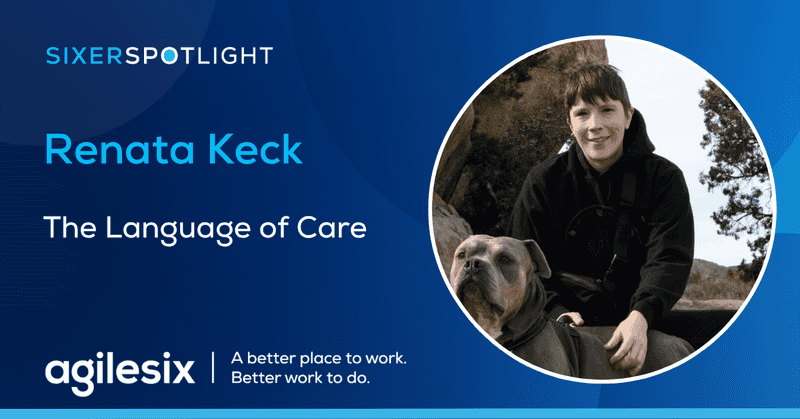
I’m based in Los Angeles and have been here for over a decade now. I do a lot of volunteering and community organizing. I’m a really passionate pit bull parent. There are many of us, but I really love my big baby boy, Lemmy. Before I adopted him, I did a lot of work with animal rescues in Southern California.
More recently, since the fires last year, I’ve been doing a lot of community organizing in my area. I mostly do logistical planning and help with the tech setup so that neighborhood action groups can actually go out on the street and do the on-the-ground work to support mostly unhoused folks in our neighborhood, providing them with a little bit more dignity and the care they need. My hobbies include knitting. I’ve been a lifelong knitter and have been doing it for 34 years. I’m a huge professional wrestling fan, and I’m a big music buff across all genres. I love going to see live music with my partner. The most recent concert we went to was an opera performance, and it was one of the best things I’ve heard in years.
From Medieval Persian Poetry to Civic Tech
You went from studying Persian poets from the 10th to 14th centuries to supporting healthcare form design for Veterans. How did you get here, and do you see the connection between the two?
Emphatically, yes, there is a connection, and I promise I will make that clear. On the face of it, those are two very different career paths and things to study. My training and interest in Persian poetry were based in a philological grounding of the text, and also a history of culture through literary expression: how do we as human beings explain who we are, our identities, what is important to us, and what our values are?
When you’re working in poetic text from the Middle Ages in another language, you’re often looking at a corpus. You’re looking at a century’s worth of work or an entire poet’s output—hundreds, if not thousands, of poems. There is a huge connection between that and doing user experience research. When we're looking at data where people are expressing their values, what is important or necessary for them to be able to apply for a healthcare benefit for themselves or for a family member, and how they describe who they are.
What goes into designing a form is a lot of how we describe who we are. We have to make sure that fits how people see themselves so that they’re able to answer the form truthfully and accurately the first time, and there aren’t mistakes.
You’re paying attention to language at the moment a person most needs to be understood and is least likely to be.
That’s a great observation. I think that’s really the point of doing user experience research and human-centered design in general: to find those moments where people are at their most vulnerable or where there are gaps between services. A thing that I say a lot is, “We don’t wake up in the morning and go, ‘I really want to fill out a form today.’” There’s usually a task, an impetus, or a goal. I’m sick, I’m worried about my health, or I’m worried about my partner’s or child’s health, and I want to make sure that we’re taken care of. There is a lot of vulnerability there. Our work is about uncovering that vulnerability, making sure that folks are getting what they need, and ensuring they feel supported the whole way through.
As far as getting to Agile Six, when I transitioned out of academia, I knew I wanted to continue to do something that made a difference. I did some real soul-searching and saw that civic tech was a place where I could apply that grounding in qualitative research that I had gotten very good at, but do it in a way that was giving back to folks and making a real difference every single day.
A Generational Legacy of Service
Service shows up everywhere. When we last spoke, you said civic engagement was instilled in your family from a young age. Where did that come from?
I think everybody in my family has always been in service-oriented positions in their careers, but the two individuals who really inspired me are my grandfathers. My paternal grandfather was a German citizen in World War II and was a humanist who was very appalled by the conditions of how folks were treating each other. He came to America to object to what was happening and to help fight against it. My maternal grandfather was a pilot and served in the European theater multiple times.
For both of them, serving others and elevating others through service was so important. I think that really instilled an ethic in everybody in my family to contribute in a meaningful way. Especially for my paternal grandfather, American citizenship was not something that you took for granted. It was something that you needed to really pay back to other folks through acts of service.
I think my sisters and I all took that in different ways in the walks that we’ve taken in life. I’m the middle of three: my older sister is a social worker at the VA, and my younger sister is a nurse who worked in the cardiac ICU and in COVID wards during the pandemic. For each of us, there’s been a service element to the careers that we’ve chosen and how we support others.
It also shows up a lot in the community work that I do outside of my job. I just think it is so important to make sure that other folks coming up have a better experience than I might have had. It's really not about what I get out of the experience. It's making sure that other folks are supported.
The Front Door to Veteran Healthcare Benefits
Let’s talk about Health Applications and the work you’re doing to support Veterans.
I’m a Staff UX researcher and designer, and the UX Lead for Health Applications. I like to consider the Health Applications team the welcome mat for Veterans, their Caregivers, and family members to the Veterans Health Administration (VHA). We work on designing and maintaining the forms that allow Veterans, Caregivers, and family members to apply for healthcare benefits, and also to maintain and use those benefits throughout their time with the VA.
The work that we do is so critical to get folks in the door and get them the care they need. The stories we hear from folks as we do this work emphasize how critical it is that these forms be online and that we support them throughout their healthcare benefits journey. I really don’t see our work as just getting them in the door and then handing them off. We make sure that at every step of the way, whenever they need to engage with a form on VA.gov to manage those benefits, there is support there for them.
Many see a form as just a task to complete. You fill it out, you’re done. What are you and your team actually paying attention to and why?
The team has taken a really intentional service design approach to forms. When you’re modernizing and digitizing forms for federal benefits, you could just do a one-to-one replica of what it looks like on a piece of paper, slap it on a website, and call it a day. But that’s not an enjoyable or supported experience for anybody.
As I mentioned with the connection to my linguistic and philological background, you need to make sure that the language and the design of these forms is intuitive and clear to folks who are maybe not sitting down to do this in ideal conditions. We hear that a lot of folks do this work on their mobile phones. They need to have the right information. We’ve found through research that folks do a lot of comparison shopping and deep research into their own eligibility before they ever touch a form. Those are all aspects of service design sitting outside of a form that we have to make sure are part of the form experience, keeping things clear so no one finds themselves rug pulled.
So when a Veteran or a family member lands on one of your forms, what changes for them because of the work your team does? And would anyone even notice?
We get feedback from folks on VA.gov that the experience they go through when applying and managing their benefits has gotten markedly better, but I don't know that anyone is going to notice the specific tweaks the team does, and that's actually part of the magic.
I want to call out just how skilled our engineers and the other UX designers and researchers are. They’ve been able to make really subtle changes to the language and to the interaction between pages so that it’s simply easier for folks to get where they need to go and submit their forms.
A 55% Drop in Errors and a Quieter Call Center: The Claims Reimbursement Form
Can you walk me through an example of that?
We had a form for a healthcare claim for getting reimbursement. Let’s say you went to the doctor, you have health insurance through your employer, it paid a portion, and you’re still out 150 bucks. This reimbursement form is to submit for reimbursement for the remainder of that.
We were in the process of rolling it out through a staged release—only opening it to a very small percentage of users. It was a canary test, effectively, to see if folks could get through the form. We’d done a lot of user research and design work up to that point. What we noticed in that live, very small set of users on VA.gov is that they were submitting incomplete forms containing user errors.
A user error occurs when a user, because of the way the form is designed, either cannot answer truthfully and has to fudge their way through, or because the instructions aren’t clear, causing them to make mistakes in how they fill out the inputs required for submission. That was the problem.
The team immediately took the form offline and audited those errors. It was really clear that the content surrounding what was needed for a complete claim was not obvious to somebody trying to get a reimbursement. So, the fix was super simple: clarifying information within the form and on VA.gov so that users could truly understand what the policy requirements were, allowing them to stop and recognize a mistake before making an error so they could resolve it and file the claim right the first time.
It took the team a little under a week to audit and fix that content. With iterative improvements over time, we’ve seen a 55% reduction in submission errors, and user satisfaction rose about 10% in roughly three months.
When I see folks say, “You know, this is so much better than the last time I had to apply for a benefit,” that means the world to me. But there’s also another group of folks who are really important to the work we do, and those are the people in the program office at the VA whom we support. We work across several programs on my team because our forms support multiple benefit programs.
In talking with them, we’ve heard that we’ve seen a reduction in calls to the call center asking how to fill out a form. We’re seeing more complete applications, and we’re seeing more people submitting updates or claims in a timely manner. That makes a huge difference. I don’t want to just have an impact on the folks applying for and using the benefit; if we’re making sure that the folks in the office who are interacting with these forms on the back end every day are having a better experience too, then that’s a job well done.
Why Agile Six?
I want to bring this back to your journey. What made you say yes to Agile Six?
When I decided to make a career transition into civic tech, I started looking for organizations that had similar values to mine and where I felt like I could make a huge difference. Agile Six was at the top of my list of companies to look for opportunities. This wasn’t just because of the values of the organization, but also because of the portfolio of work.
My best friend in college is in the Air Force, and I witnessed him experiencing the medical side effects of burn pits. To see that Agile Six had a portfolio touching on toxic exposure, legacy healthcare forms, and other disability benefits made me realize, “I would get to make a difference in my friend’s life if I got to work on this stuff.” Agile Six pursues incredible, purpose-driven work. Even if I wasn’t going to touch that specific work, I knew I was going to make a difference wherever I landed here.
The Freedom (and Challenge) of a Self-Managed Culture
At past companies, you spent a lot of time managing up because management wasn’t really doing their job. What’s different now?
I’ve been at companies where managers explicitly told me that the expectation was to manage up. I always found that quite frustrating because the expectation is not to just do your job, but to go above and beyond and perform at a baseline level higher than your own. It’s unsustainable and contributed to a lot of the burnout I experienced before coming to Agile Six. Without proper management and support, getting the opportunity to work at a higher level is very challenging, and I often didn’t feel like I had the support to try making those jumps.
At Agile Six we’re self-managed, which is a blessing but also a challenge. It means everybody really has to show up and be honest every day about the capacity they have and the work they’re able to do. But it’s also a culture where it’s okay to fail and to try, and I really appreciate that. It has allowed me to do a lot of internal initiatives. Beyond trying new things on my team, I get to try new things within the organization so that everybody can build community better.
Most recently, I’ve been active with some other human-centered design (HCD) Sixers to reboot our Community of Practice, and that was completely self-organized. We came together and said, “Hey, the community has been through a lot this year. There have been a lot of changes in the way we work, folks are feeling burnt out, and how do we make sure everyone is supported so this remains a place where everyone wants to show up and do the work?” In a traditional organization, I would have had to ask permission to do that. Instead, we just took the idea and ran with it. I love working with other UX Sixers because we kind of did a user experience on our own organizational experience, and it’s been great.
Do you think you’re helping build a better place to work?
Yeah, I really hope so. To anyone listening, if I’m not, please let me know! When I came here, I was really excited about the self-managed aspect at Agile Six and the opportunity to jump in and support internal community growth. I know that some folks just want to show up and do their day job, or they don’t have the capacity for extra initiatives. So my goal was really: if I can do anything for internal company culture so that it’s easier to jump in, there’s more opportunity, and there’s excitement to engage for anyone who comes in after me, then that’s a success.
With the work that myself and some of the other folks have been doing for the Human-Centered Design Community of Practice and for the accessibility community here at Agile Six, I want to make that community connection clear. I want folks, even if they’re the only UX person or the only accessibility person supporting their team, to feel like they have a whole community behind them. I think that’s one of the strengths of being self-managed—you’ve got that community. Our work ahead of us is just to make that clearer and to help folks feel supported in their day-to-day.
Advice & Tips
What advice would you give someone who’s thinking about joining Agile Six?
Pace yourself. That’s going to sound a little odd, but the hiring process can be a whirlwind sometimes when we’re staffing up a new team. There are also just so many opportunities for engagement once you’re here. Without those traditional management paths, it’s up to you to choose your own adventure, and I see a lot of folks jump in with both feet. We don’t want you to burn out. There is time.
Give yourself the space to relax, expand into your team, and eventually make those relationships beyond your immediate team to figure out what feels comfortable for you. I really want to encourage folks to have sustainable personal and professional growth here. That’s just so important in the work that we do. I don’t want to see you burn out right away, so pacing is very important.
Opportunities for Growth
You brought up opportunities for growth. What are they?
Well, they might not look the same way they do at a traditional organization. We don’t do performance evaluations, and we don’t do traditional promotional cycles. That’s something we’re currently talking about—how to make it clearer for folks where those professional opportunities lie. We’re doing a little bit of UX work on our internal tools to help folks better chart and plan out their professional development, exploring how their personal and career goals can converge.
For me, it’s been really wonderful to have those non-traditional opportunities for professional growth. There are a lot of things that I want to get better at in my career, and I want the opportunity to do all of it without having to tie them to specific performance goals every year. I get to pick what I want to do. For some folks, those choices can be a little bit paralyzing. But you get the opportunity to work on everything here if you really want to—from social and community engagement within the company to opportunities to work on business development and bids for new work, or supporting our Communities of Practice. We’re always looking for new folks with new ideas, so there’s really room to choose your own adventure here. But doing so sustainably is what really, really matters.
A Unified Theory of Good Neighboring
You said something that really stuck with me: that being a good neighbor in any walk of life is the most important thing to you. Why?
I consider good neighboring to be my unified theory of how I choose to live my life, in such a way that I'm not going to make anybody's lives harder. I’m there if they need a cup of sugar, or if they need batteries in the middle of the night. That mindset also shows up in the work that I do, especially the work that I’ve done internally at Agile Six and on my team. I want to make sure that anybody coming in new is going to have a better experience than the last person. I want to make sure that everybody feels heard, seen, and supported. Making sure that everyone has what they need just to show up every day and do their job really means a lot to me.
There’s just one more thing I want to add: it does show up in my day-to-day. Life’s tough, and I think everyone’s feeling it these days. A little bit of kindness to a stranger is so important. I think it’s become increasingly rare just with how stressed everybody is, but I really do think being a supportive presence for folks and showing a little kindness goes a long way.
Final Thoughts
Agile Six is an experience. It is unlike any other organization that I’ve ever worked for. The work that we get to do is so impactful, and I’m just so grateful for the opportunity—not just to do that work for the VA, Veterans, and their family members, but to get to give back to the organization as a whole as well.
Sixer Spotlight is an ongoing series to share the stories of our team. If Renata’s story piqued your interest in a career with Agile Six, explore our open roles.